
Leadership Without Crutches
We all want to support our people, but what if the help we offer quietly makes them weaker? In this post, you’ll see a real example of good intentions gone wrong: calendar “crutches” meant to drive preparation that instead created noise and dependency. If you’ve ever wondered where the line is between removing obstacles and removing accountability, this article gives you a clear lens and practical alternatives to build true capability: speak up, reframe the benefit, and replace rescue with growth. Read on, and ask yourself whether you’re clearing the path, or carrying the load.
5/12/20262 min read
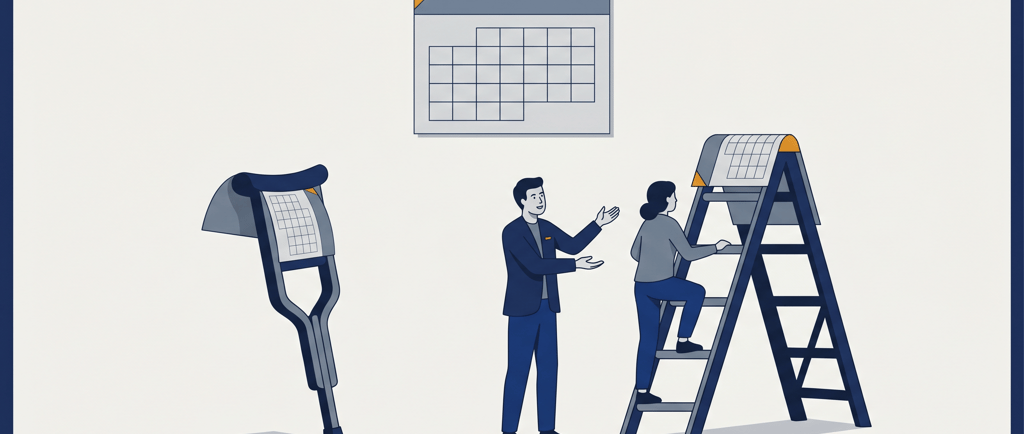
In the corporate world, we often talk about "supporting our people." We want to be the leaders who remove roadblocks and pave the way for success. But there is a thin, dangerous line between guiding someone to grow and solving their problems for them. I recently encountered this in my new role as Lead Data Steward. Our training program is rigorous: 90-minute live sessions underpinned by essential recorded prerequisites. It’s a lot of work. When the organizer noticed that only a fraction of the 200 participants was actually watching the prep materials, he decided to "help." His solution? Flooding everyone’s calendars with massive blockers, filled with pages of text and repeated instructions. The goal was to "manage their time" for them.
When I spoke up against this, the defense was that people asked for this support. They needed help prioritizing. But this brings us to a fundamental question of alignment: are the right people in the right positions? There are two types of people who "cannot" manage their calendars. The first is the high-level executive whose schedule is so complex it requires a dedicated secretary; these people are rarely the ones doing the deep-dive work of a Data Steward. The second type is the professional who hasn't yet mastered self-organization.
If a role requires high levels of ownership and precision – like managing critical data – how can someone succeed if they cannot yet manage their own time? And more importantly: If we manage it for them, how will they ever learn? By creating these blockers, the organizer wasn't teaching time management; he was reinforcing a "learned disability."
When we solve a problem for someone else, we rob them of the struggle required to develop a new skill. Problem-solving is a muscle. If a coach lifts the weights for the athlete, the athlete remains weak. In a corporate setting, if we provide the "crutches" before someone has even tried to walk, we ensure they will never run.
Unsurprisingly, the "calendar blocker" method failed. It didn't change the behavior; it just added more noise to an already crowded digital workspace.
In these situations, it is tempting to stay silent and just delete the blockers. But Presence and Courage demand more from us.
If you find yourself in a similar environment, here is how we can advocate for real growth:
Speak up in the right forums: Silence is a form of agreement. Highlight the concern not as a complaint, but as a strategic misalignment.
Argue from the "Benefit" perspective: Explain why the current "help" actually weakens the team. If the goal is a team of independent, capable stewards, the support must mirror that goal.
Propose the "Growth" alternative: Instead of doing the work for them, offer tools that empower them. Don't block their calendar; instead, hold a session on how to integrate deep-work habits into a busy schedule.
The next time you are tempted to "fix" a situation for your team, ask yourself: Am I clearing a path for them, or am I taking away their opportunity to learn how to clear it themselves?
Real support isn’t about making the work disappear. It’s about building the person, so they are strong enough to handle the work.