
Tuning the Receiver
Ghosting, mixed signals, and one smart insight: this article turns workplace miscommunication into a sharp lesson in better listening. Honest, tense, and highly relatable, Tuning the Receiver will hook anyone who has ever felt unheard, and make them want to read on.
6/2/20263 min read
What Ghosting and Miscommunication Taught Me About Listening
We have all been there. You spend three months in meticulous alignment with an expert colleague. You map out the structure, agree on a proof-of-concept prototype, and wait for the technical interface they promised to build. And then – silence. They disappear. Emails go unanswered, Teams messages fade into the digital ether. You’ve been ghosted.
In a corporate environment, especially when you don’t share a reporting line or a manager with the person, navigating this without creating unnecessary drama is a tightrope walk.
Recently, when this happened to me, I decided to bypass the bottleneck. I scheduled a meeting with an operative colleague from my own group who works within that same technical system, hoping he could help me build the interface.
Instead, I walked right into a communication storm.
It is incredibly difficult to compress three months of deep, aligned discussions into a thirty-minute meeting with someone who has zero context. He partially understood, but lacked the authority to make a decision, so he pulled our group leader into the conversation.
Suddenly, I found myself summarizing the entire backstory all over again, defending a problem they couldn’t quite see.
To make matters more complex, the meeting was held in German. Neither the operative colleague nor I are native German speakers; we both know our technical domains intimately, but we lacked the precise vocabulary of the other’s world. Our manager, a native German speaker, understood the corporate landscape but wasn’t an expert in either of our specific technical areas.
I left that meeting feeling stuck, frustrated, and completely devastated. I didn’t have the "perfect" technical words, and it felt like my message had crashed into a wall. Even though we technically established a next step toward a solution, my internal engine was burning out from the friction.
But then, something remarkable happened overnight. The next morning, I didn’t let the frustration fester. I took responsibility for my communication. I reached out to the operative colleague via email, laying out the unclear points with newly created illustrations – this time, in English. Almost simultaneously, my group leader reached out to me with a calm, constructive offer to gently escalate the issue with the colleague who had ghosted me, bypassing the drama entirely.
Without anyone explicitly saying it, every single one of us had gone home and done the reflection work. Nobody pointed fingers. Nobody blamed the other for "not getting it." Instead, we all recognized that the information simply hadn’t landed as intended, and we immediately tried again through different channels, different languages, and different forms. And it worked.
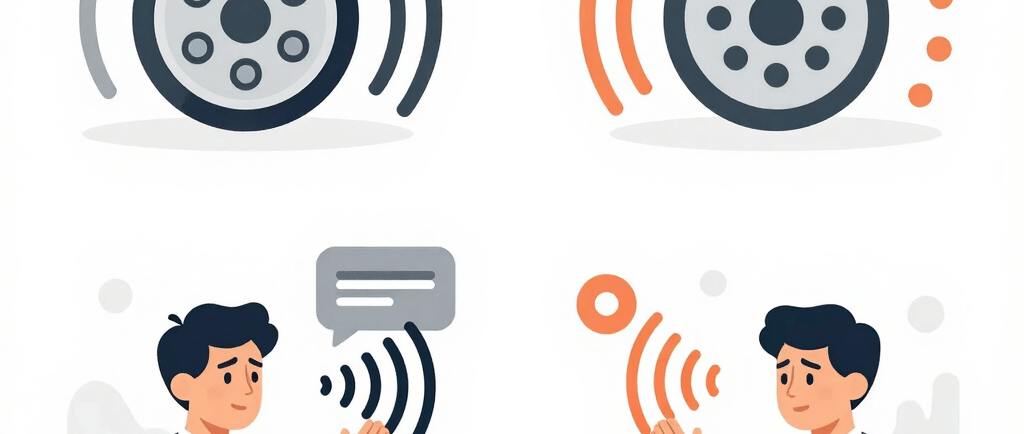
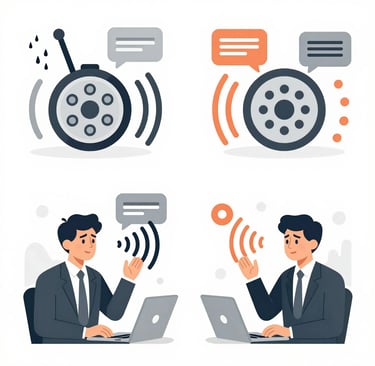
As someone who lives and works almost entirely in learned languages, rarely using my mother tongue, I’ve developed a specific habit of mind: I automatically assume that if my message didn't land, it's simply because the other person's internal "receiver" is set to a different frequency. I do this entirely without judgment. It forces me to become a deeper listener. It forces me to quiet my own internal monologue and pay attention to how the other side is processing information so I can fine-tune my transmission to match their dial.
Conversely, when I receive a message that feels jarring, confusing, or unhelpful, I apply the same grace. I assume my receiver might be misaligned to their context, and that the true intent behind their words might be completely different than my initial reaction.
Our differences – whether they are linguistic, cultural, or purely technical – don’t automatically make us better or worse than one another. They just make us different. The key to reliable, sustainable transformation in our communication isn’t forcing the other person to speak our language or match our speed. It is the willingness to listen to understand, to ask clarifying questions, and to actually listen to the answers before we react.
This week, I invite you to look at a point of friction in your own work or life through this filter. If a message didn't land, or if a colleague seems defensive, drop the blame.
What if their receiver is just set differently? How can you adjust your dial to meet them where they are?