Why There Is No "Help Others" Section
Are you ready to rethink what it truly means to help others? This article dives beneath the surface of self-help culture, questioning why bookstores overflow with guides for personal improvement but leave "helping others" strangely absent. Through personal anecdotes and sharp observations, it challenges us to rediscover the power of genuine listening and presence. If you've ever wondered why so much help feels hollow, or how real support can transform relationships, this thought-provoking read will spark your curiosity and inspire a new perspective on connection. Don’t miss the journey from self-optimization to authentic generosity. Your next conversation might just change forever.
5/4/20262 min read
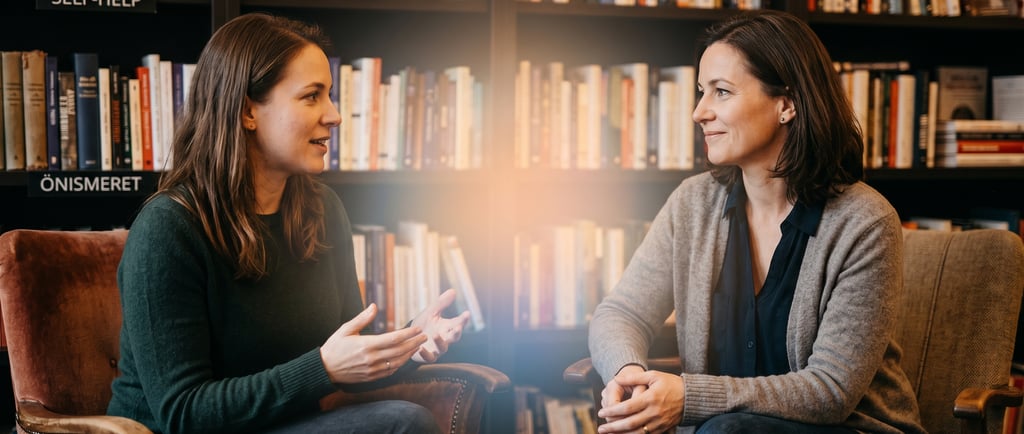

Every morning, the rhythm of the road is accompanied by the voice of Simon Sinek. In several episodes of A Bit of Optimism, he points out something and it stays with me every time long after I parked the car: Walk into any bookstore, and you will find massive sections dedicated to "Self-Help." Yet, there is no section for "Helping Others."
I believe Simon is highlighting a quiet crisis in our modern world; we have become so focused on our individual survival and "optimization" that we’ve forgotten the biological truth that we only thrive through cooperation. To me, his observation is a call to return to our roots as social beings who find purpose in supporting one another.
Yet, as I reflected on this, I realized why a "manual" for this might be missing. As social animals, our survival – our very history as Homo sapiens – is rooted in the power of the collective. But you cannot teach someone to help if they haven't first learned how to listen.
I grew up in the shadow of a "helper." My mother was someone who, in her own world, was always trying to assist me. But there was a catch: she never actually heard me. My needs were invisible to her; she was helping a version of me that existed only in her mind. When I didn't want that specific help, the narrative shifted, and suddenly, I was the ungrateful child.
This taught me a painful but vital lesson: Help that isn't rooted in listening is often just an exercise in ego. It isn't about the other person; it’s about the helper feeling seen, needed, or superior.
For a long time, I carried a habit I think many of us share. I would sit across from someone, watching their lips move, while my mind was busy rehearsing a response. I wasn't listening; I was waiting. I was trapped in my own perspective, fueled by a subtle lack of confidence, a need to have the "right" answer to prove my own worth. It took conscious practice to catch that internal monologue and let it go. I had to learn to replace my "answer-script" with curiosity.
The reason the "Self-Help" section is so full is not that we are a selfish society. It’s that so many people are still looking for their own authentic center. They are searching for the feeling of being truly heard because they haven't found it yet. Not within themselves or from others.
Real help requires a level of inner harmony. You have to be steady enough in your own skin to set your perspective aside and simply be a mirror for someone else. When we are no longer desperate to fix ourselves or defend our viewpoints, we finally have the "room" for someone else to sit down.
This week, I invite you to a small experiment in presence – the exact meaning of JelenLét.
The next time a friend, a colleague, or a partner speaks to you, notice your mind. Are you preparing a monologue? Are you waiting to "help" them with your own advice?
Try, just for a moment, to let your ideas go. Keep up your curiosity. Notice what happens when you stop listening to answer and start listening to understand.
You might find that the best way to help someone isn't to give them a solution, but to give them the rare experience of being truly seen.